
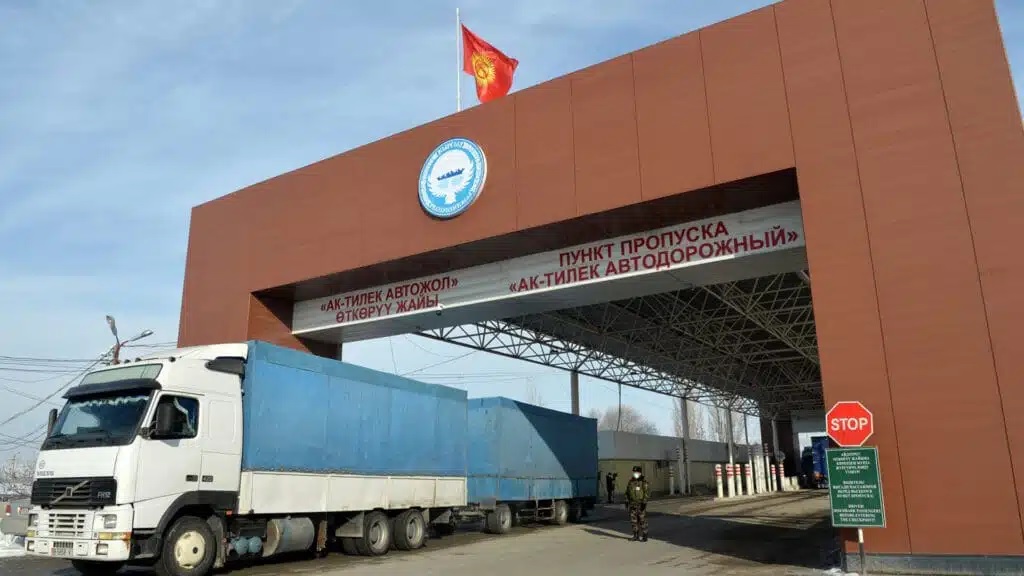
The EAEU's mechanisms are being tested in the most challenging sector of the economy
Year after year, with the onset of the first fruit and vegetable harvest season, kilometers-long queues of trucks form at the Kyrgyz-Kazakh border. The last days of March became a severe test of endurance and patience for drivers of heavy-duty trucks with Kyrgyz license plates stuck in the traffic jam.
Entry into the neighboring country is complicated by scheduled inspections by Kazakh customs officials to check for navigation seals, product markings, and the detection of contraband and prohibited substances. When such checks are carried out, drivers know the delays will be lengthy, and even artificial intelligence is powerless to speed up the process.
Since 2025, the Ak-Tilek and Karasu checkpoints, and since early 2026, the Kegen and Kordai checkpoints, have been operating the CarGoRuqsat electronic queuing system, designed and implemented to eliminate queues. Cargo carriers only need to book a day and time of travel in advance, providing their and their vehicle's information. The smart program, integrated with 18 information systems, will do the rest, automatically checking the client for fines and documents. If everything is in order, the cargo is cleared, passage is clear, and they can continue their journey.
This electronic queuing system is currently in operation at 34 checkpoints between Kazakhstan and the EAEU countries. It has also proven successful on the republic's borders with China, Uzbekistan, Turkmenistan, and Russia. Since the system's introduction, hundreds of thousands of cargo carriers have used the service.
In August 2025, the State Revenue Committee of the Ministry of Finance of the Republic of Kazakhstan and the Tax Service of Kyrgyzstan signed a memorandum of cooperation on the implementation of digital solutions at the border.
The parties agreed to implement a pilot project for electronic queuing at the Aisha Bibi (Kazakhstan) and Chon-Kapka (Kyrgyzstan) vehicle checkpoints. Plans include introducing the digital system at all checkpoints along the border between the two neighboring republics.
Advanced technologies will maximize the speed of border crossings, ensure transparency of procedures, and reduce the risk of unexpected inspections and corruption, as all processes are recorded and processed through digital channels.
The introduction of digital accompanying documents for goods in Kazakhstan (consignment notes) and electronic invoices in Kyrgyzstan allowed parties to seamlessly exchange information about companies and goods, making contracts more transparent and reducing the number of inspections. This coordination allowed for further development and the implementation of electronic queuing.
Nevertheless, problems with unimpeded passage through checkpoints within the EAEU remain. Drivers from Kyrgyzstan complain that the free movement of goods and services is actually limited. These include inspections, which can last for hours. The resulting congestion makes carriers nervous about the condition of their perishable cargo. Documentation requirements not stipulated by EAEU regulations also pose a barrier.
The Eurasian Economic Commission is aware of the problems at checkpoints and, to address them, has proposed that countries introduce electronic navigation seals for tracking shipments. These seals will become mandatory for all participants in foreign economic activity starting in February 2026. According to the State Tax Service of the Kyrgyz Republic, the navigation seals will be introduced in stages. Initially, they will apply to road and rail transport, and the seals can only be removed at the recipient's premises or when unloading the wagons at designated railway stations. However, drivers doubt this innovation will deter border and customs services during inspections in Kazakhstan, since they ignore the presence of electronic invoices.
The country's authorities hear the complaints of carriers and know they are not unfounded. This is a recurring pattern year after year. Recently, at a meeting of the relevant committee of the Kyrgyz parliament, which was considering a draft protocol amending the agreement on the specifics of criminal and administrative liability for violations of the customs legislation of the Customs Union, deputies again raised the issue of barriers to the export of goods from Kyrgyzstan related to the transfer and transit of goods through the neighboring republic.
When asked "how long will this continue and what should be done?" Deputy Minister of Economy and Commerce Sultan Akhmatov promised that if violations of the requirements and procedures in force within the EAEU are detected, the Ministry of Economy will send letters to the EEC.
Meanwhile, the Eurasian Economic Commission previously clarified that it does not have the authority to arbitrate inter-country conflicts. Therefore, the resolution of border disputes must be handled by the parties themselves. All responses from the Eurasian Economic Commission to inquiries and complaints can only be advisory in nature.
According to Eurasian integration expert Pavel Vlasov, interaction with the sovereign system of another state must be structured in a special way.
— Eurasian integration is not just about duty-free access to a foreign market, budgetary replenishment from labor exports, or lucrative financing from a joint financial institution, — he asserts. — Eurasian integration is a comprehensive business agenda involving government agencies and public response bodies, public diplomacy, the media, and research.
He believes that barriers have always existed, exist, and will continue to exist. Because in addition to common Eurasian interests, there are internal ones that are a priority for each country.
— Article 29 of the Treaty on the EAEU allows states to impose temporary restrictions on mutual trade if they affect the life and health of humans, animals, and plants, the environment, public morality and law and order, and national security, — he commented on the queue issue. — It's enough to declare that certain products from another country pose a threat to public health due to non-compliance with standards, and shipments can be temporarily blocked. Time passes, joint investigations take place, commissions collaborate, the source of the threat responds, the situation is resolved, and the block is lifted. However, this wastes the carrier's time, and the supplier suffers losses.
Confirming Pavel Vlasov's statements, reports are emerging that Kazakhstan has stepped up border inspections with Russia, explaining this by monitoring the transportation of specific goods, checking documents, and identifying cargo whose export is prohibited. However, customs officials are not violating any rules, as EAEU members "have the right to impose restrictions in mutual trade if such restrictions are necessary, including to fulfill international obligations, as well as to ensure national defense and the security of the member state." It follows that Kazakhstani authorities are applying national legislation in this case.
Russia adheres to a similar position, introducing permanent customs controls on the borders with Kazakhstan and Belarus. He also explains this by protecting the domestic market from unfair imports and the illegal import and export of goods.
At the same time, all participants understand that disputes, like queues at checkpoints, hinder the EEC's efforts to implement new technologies for expedited clearance of goods and their free movement within the Union's common market. Therefore, they must still be resolved. Where? In the EAEU Court?! However, it is strange that the court case register, over the years of this judicial body's operation, has not found a single complaint from Kyrgyzstan regarding border barriers, inspections, or broken seals. This indicates insufficient efforts by Kyrgyz officials to protect their country's interests.
Meanwhile, despite certain difficulties, according to the National Statistical Committee, the republic is increasing its freight traffic. Since the beginning of the year, approximately 4 million tons have been transported by road, a 9.2 percent increase over the 2025 target. Moreover, heavy-duty vehicles account for 82 percent of the total volume of goods, raw materials, and other materials transported to their destinations.
Text adapted by AI. Should it lack clarity, read the original RU-ver.
Larisa Li
Specially for the Business Eurasia