
Moscow Sets Priorities for Collective Defense Through 2030
The CSTO summit in Moscow has signaled a shift toward a comprehensive model of Eurasian security. Military cooperation is now being supplemented by the protection of communication networks, information systems, and critical infrastructure. For Central Asia, Russian security guarantees and the joint development of defense capabilities have taken on particular significance. The decisions reached also have implications for the resilience of economic integration and the Greater Eurasian Partnership.
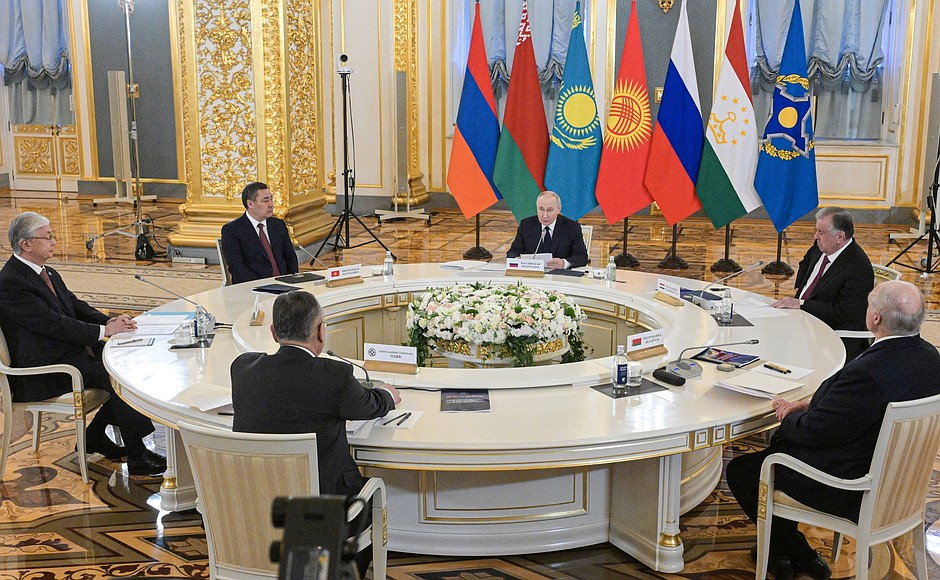
On November 11, 2026, a session of the Collective Security Treaty Organization (CSTO) Collective Security Council was held in Moscow. The meeting was chaired by Russian President Vladimir Putin and attended by Alexander Lukashenko, Kassym-Jomart Tokayev, Sadyr Japarov, and Emomali Rahmon.
The expanded session included the heads of the CIS and the SCO. This level of representation reflects the need to coordinate security across the Greater Eurasian space. The meeting concluded with the adoption of a declaration and a package of documents aimed at the organization’s development. Of particular note is the CSTO’s Counter-Terrorism Strategy, which extends through 2030.
Vladimir Putin summarized the outcomes of Russia’s chairmanship and outlined the path for future development. He noted that the leaders reached a near-complete consensus during their closed-door discussions. The President specifically highlighted the development of the air component of the collective forces, as well as plans to establish mobile air defense units.
"There is a reaffirmed commitment to continued joint efforts in countering acute challenges and threats to our collective security," Vladimir Putin stated. The Declaration adopted by the Collective Security Council outlines five interconnected areas of focus. The first involves strengthening a multipolar system of international relations and the central role of the UN. The second concerns strategic stability, nuclear disarmament, and the non-proliferation of weapons. The third addresses the need to counter military threats, including the deployment of armaments near the borders of member states. The fourth encompasses security in the space, information, biological, and maritime domains. The fifth focuses on the development of collective forces, counter-terrorism coordination, and cooperation with the CIS and the SCO.
The provisions regarding the security of maritime communications are particularly noteworthy. The Declaration highlights the increasing number of attacks by unmanned systems on merchant vessels and port infrastructure. The document specifically mentions the Black, Caspian, Baltic, and Mediterranean Seas. Consequently, the security of maritime routes has become a direct factor in Eurasian trade.
Meanwhile, the nature of modern conflicts has changed significantly. The Russia-Ukraine conflict—the "Special Military Operation"—has demonstrated the scale at which drones and electronic warfare systems are now employed. Aggressive actions involving Israel and the U.S. against Iran have also highlighted the vulnerability of energy infrastructure. Military operations increasingly integrate aviation, missiles, unmanned systems, cyberattacks, and information warfare.
According to NATO assessments, artificial intelligence and autonomous systems are altering defense requirements. Research by SIPRI notes the proliferation of low-cost attack drones. Consequently, modern defense necessitates the coordinated efforts of intelligence, air defense, cyber-defense, and the industrial sector.
For Eurasia, the implications extend well beyond the military sphere. The escalation of conflicts drives up the costs of cargo insurance and transport operations. Disruptions to maritime routes affect the supply of fuel, food, and industrial raw materials. The movement of terrorist networks and illicit weaponry creates additional risks for Central Asia. Thus, security has become a prerequisite for the stability of economic ties within the Eurasian Economic Union (EAEU).
For Kyrgyzstan, military-technical cooperation with Russia remains of particular importance. In May 2026, Sadyr Japarov signed a law ratifying a protocol to an agreement with Russia. The document streamlines the supply of armaments, spare parts, and specialized equipment, providing a foundation for the accelerated modernization of the Kyrgyz military’s technical capabilities. In mountainous terrain, mobile air defense, reconnaissance, and unmanned systems take on particular importance. Developing a comprehensive suite of such capabilities independently would require significant financial resources. Cooperation with Russia provides access to technologies, personnel training, and technical maintenance. For neighboring states, such a system also creates additional opportunities for coordination.
The military potential of the organization’s member states varies. Russia possesses the primary industrial, technological, and strategic resources of the collective system, while Belarus, Kazakhstan, Kyrgyzstan, and Tajikistan each have different national military capabilities. According to 2025 data from SIPRI, global military spending reached $2.887 trillion. Expenditures in Europe rose by 14%, while those of Asian states increased by 8.1%. This reflects an overall intensification of the military dimension of international competition.
Bilateral relations between the participants take on particular significance. Vladimir Putin and Sadyr Japarov held talks on investment and trade-economic cooperation. The Russian president noted that trade turnover between the two countries has grown by more than 25%. Kassym-Jomart Tokayev highlighted the fight against terrorism, drug trafficking, and information-related threats. The Kazakhstani president paid special attention to the use of artificial intelligence. Emomali Rahmon outlined the priorities for Tajikistan’s upcoming chairmanship. Alexander Lukashenko participated in coordinating the collective security agenda.
The European and American security agenda is developing in parallel. During talks in Abu Dhabi on November 10, representatives from the EU, the U.S., NATO, and Ukraine discussed future security guarantees. The European participants reaffirmed NATO’s central role in Euro-Atlantic defense. No direct official assessments of the Moscow Declaration by Western leaders have been published thus far. Foreign media coverage has primarily focused on the absence of the Armenian leadership and internal divisions within the organization.
In this context, the future interaction of the CSTO with the CIS and the SCO takes on particular importance. Economic integration within the EAEU requires robust transport and energy infrastructure. The coordinated development of the two organizations allows for security and the economy to be viewed as interconnected areas.
On January 1, 2027, the chairmanship of the CSTO will pass to Tajikistan. This marks the beginning of a new phase in aligning the priorities of Central Asian nations. For Kyrgyzstan, joint military training, the modernization of armaments, and the protection of border regions are of particular importance. For Russia, the priority lies in maintaining a stable system of allied cooperation.
Thus, the meeting in Moscow defined more than just the organization’s military priorities; it highlighted the need to integrate the defense, technological, and economic capabilities of the member states. It is precisely this alignment across these areas that serves as a crucial prerequisite for the sustainability of the Greater Eurasian Partnership.
Text adapted by AI. Should it lack clarity, read the original RU-ver.
Own.info
Business Eurasia